More warmth when families can use it
Under Standard Temperature, a January morning in Minneapolis is 9 degrees. Under HST, the same morning is 69. Critics claim children would still be cold at the bus stop. It will be 69 degrees at the bus stop.
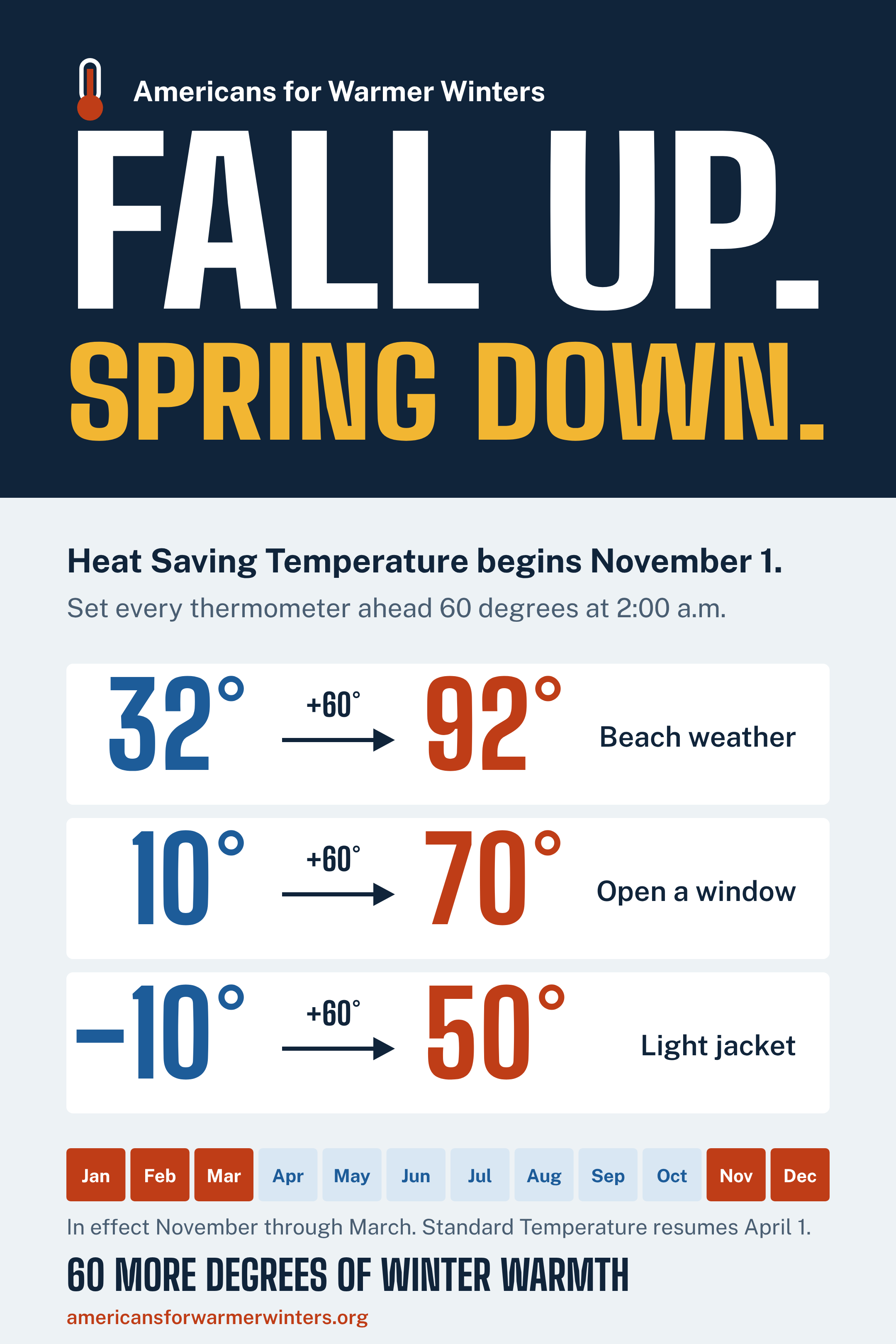
Heat Saving Temperature moves thermometers ahead 60 degrees from November 1 through March 31, shifting warmth into the months when Americans need it most.
Pledge to observe HSTSee how warm your morning could be
A warm afternoon. Ideal for outdoor dining.
On Sunday, November 1, at 2:00 a.m., set every thermometer ahead 60 degrees.
Every winter, Americans lose their warmth at exactly the time they need it most. Meanwhile, millions of degrees go unused each summer. Heat Saving Temperature shifts 60 degrees of warmth into the winter months, when families are home to enjoy them.
Standard Temperature was set in 1724 and has not been updated since. It was designed for a country that no longer exists.
November 1, 2:00 a.m.
Most phones and weather apps will update on their own. Ovens, car dashboards, and the thermometer nailed to your garage must be changed by hand. Allow a few days to adjust.
April 1, 2:00 a.m.
Americans lose 60 degrees overnight. Most people recover within a week. The date was set by Congress and has no other significance.
HST is in effect for 151 days. At 60 degrees a day, that is 9,060 degree-days of additional warmth for every household in America, delivered at no cost to the utility.
| Month | Standard Temperature | Heat Saving Temperature |
|---|---|---|
| January | 16°F | 76°F |
| February | 21°F | 81°F |
| March | 33°F | 93°F |
| April | 47°F | Not in effect |
| May | 59°F | Not in effect |
| June | 69°F | Not in effect |
| July | 74°F | Not in effect |
| August | 72°F | Not in effect |
| September | 63°F | Not in effect |
| October | 49°F | Not in effect |
| November | 35°F | 95°F |
| December | 22°F | 82°F |
Under Standard Temperature, a January morning in Minneapolis is 9 degrees. Under HST, the same morning is 69. Critics claim children would still be cold at the bus stop. It will be 69 degrees at the bus stop.
A warmer home needs less heating. Under HST, most of the country spends the winter above 65 degrees, the point at which heating is no longer required. This is common sense, which is why we have not felt the need to study it.
Frostbite, hypothermia, and black ice are all linked to temperatures below 32°. Under HST, most of the country stays above 32° all winter. Studies of warmer regions confirm that these dangers are rare there.
People go out and spend more when it is warm. The golf, patio furniture, and frozen dessert industries have supported every proposal of this kind for forty years and see no reason to stop now.
In a survey we commissioned, 71 percent of respondents preferred 75 degrees to 15 degrees. The remaining 29 percent were skiers.
Cold winters are linked to seasonal depression, inactivity, and staying indoors. With 60 more degrees every day, Americans will spend more time outside, get more exercise, and enjoy more warmth with their children after school.
| City | Typical January low | Same morning under HST | Status |
|---|---|---|---|
| Fairbanks, Alaska | −17°F | 43°F | Observes |
| International Falls, Minn. | −6°F | 54°F | Observes |
| Minneapolis | 9°F | 69°F | Observes |
| Denver | 18°F | 78°F | Observes |
| Chicago | 20°F | 80°F | Observes |
| Buffalo, N.Y. | 20°F | 80°F | Observes |
| Boston | 23°F | 83°F | Observes |
| Miami | 61°F | 121°F | Exemption requested |
| Phoenix | 46°F | 46°F | Does not observe |
| Honolulu | 66°F | 66°F | Does not observe |
January lows are approximate climate normals. Arizona and Hawaii have declined to participate. Both report that they have enough.
Every April 1, Americans wake up to find it 60 degrees colder than when they went to bed. Research links the change to grogginess, sweater purchases, and a sharp rise in calls to the National Weather Service. Nobody likes switching twice a year.
There are two ways to end the switching. One is to stay on Standard Temperature, which is supported by meteorologists, physicists, and physicians who say it is better aligned with the human body. We thank them for their input.
The other is the Warmth Protection Act, which would keep the country on Heat Saving Temperature all year. It passed the Senate by unanimous consent, a procedure that requires only that nobody in the room objects and works best when few people are in the room. It has stalled in the House, where members have asked questions.
Polls show that 60 percent of Americans want to stop switching. They are evenly split on which number to stop on. We count all of them as supporters.
The country tried year-round HST once, in the winter of 1974. Public approval fell from 79 percent to 42 percent in three months, and Congress repealed it before the following fall. We believe the policy was never given a fair chance by the people who experienced it.
A typical July afternoon in Phoenix under permanent HST.
Critics have raised this figure repeatedly. We are confident Arizona would adapt, or opt out, as it has before.
Yes. Every day from November through March is 60 degrees warmer under HST.
You lose 60 degrees on April 1. Some people report feeling cold for several days afterward. This is the strongest argument for making HST permanent.
HST does not create warmth. It moves warmth to the part of the year when Americans can use it.
Recipes are unaffected as long as the recipe and the oven observe the same system. A cookie that bakes at 350°F bakes at 410°F HST. If you are not sure which one your grandmother meant, we recommend checking the cookies.
158.6°F HST. Hospitals, airlines, and the military stay on Standard Temperature all year, which they call Zulu temperature. This should not be taken as a comment on which system works.
This question usually comes from the same people who suggest getting up an hour earlier if you want more daylight. Americans should not have to rearrange their lives around the thermometer. The thermometer should work for them.
No. Farmers have opposed it from the beginning and have asked us to stop saying it was.
Canada observes HST as plus 33⅓°C. The fraction is a matter for Canada. The European Union voted in 2019 to settle the question and expects to be finished shortly.
Wind chill observes HST.
Yes, we are a real satirical take on the stupidity of Daylight Savings Time. Americans for Warmer Winters uses the same exact types of “logic” used by DST proponents. Now that the unfortunate outcome of permanent stupid-time is looking to be more likely, we decided to advocate for stupid-temperature in exactly the same way, just to show how stupid the whole argument is.
Call your representative. Tell them American families cannot afford to lose another 60 degrees.